Showing posts with label steam. Show all posts

The Role of Boiler Drum Level Instrumentation and Controls

The Role of Boiler Drum Level Instrumentation and Controls

Boiler drum level instrumentation and controls play a crucial role in the power generation and process control industries, ensuring steam-generating boilers' safe and efficient operation. These instruments and controls primarily manage the water level within the boiler drum, maintaining it within a specific range to ensure the boiler operates effectively and safely. Their critical functions break down as follows:


  1. Safety: A boiler's primary objective is to produce steam, which requires a precise water and heat balance. If the water level in the boiler drum is too low, the boiler tubes could overheat and cause a failure or even a catastrophic explosion. Conversely, suppose the water level is too high. In that case, excessive water may be carried over into the steam system, causing damage to downstream equipment and reducing the overall efficiency of the power generation process.
  2. Efficiency: Maintaining the optimal water level in the boiler drum ensures efficient heat transfer, which directly affects the overall efficiency of the power generation process. The steam produced in the boiler drives turbines and other equipment, so maximizing its efficiency is essential for minimizing fuel consumption and reducing emissions.
  3. Monitoring and control: Boiler drum level instrumentation and controls continuously monitor the water level, allowing for real-time adjustments. They typically include level sensors (such as float switches, conductivity probes, or radar transmitters), which send signals to a control system. This control system can be a dedicated controller, a distributed control system (DCS), or a programmable logic controller (PLC), which processes the signals and adjusts the feedwater flow into the boiler drum to maintain the desired water level.
  4. Alarm and trip functions: The instrumentation and controls also provide alarm and trip functions to notify operators of abnormal conditions or to shut down the boiler if necessary. These safety features protect personnel, equipment, and the environment from potential damage caused by boiler malfunctions or failures.
  5. Regulatory compliance: Boiler drum level instrumentation and controls are subject to stringent regulations and standards in many jurisdictions. Properly functioning instrumentation and controls are necessary for ensuring compliance with these regulations, which aim to protect human life, property, and the environment.


Boiler drum level instrumentation and controls are critical in the power generation and process control industries because they ensure steam-generating boilers' safe, efficient, and compliant operation. By maintaining the optimal water level in the boiler drum, they help to prevent accidents, optimize power generation efficiency, and adhere to regulatory requirements.


Energy West, Inc.
1955 West Industrial Circle
Salt Lake City, Utah 84104
Phone: 801-262-4477
Fax: 801-261-0862
Web: https://energy-west.com
For Industrial Steam Systems, Condensate Draining Is a Must

Condensate Draining Is a Must
Abstracted from a technical article from Armstrong International

In a steam system, condensate is a byproduct of heat transfer. It accumulates in the distribution system as a result of unavoidable radiation. It also forms in heating and process equipment due to the desired heat transfer from the steam to the heated substance. The hot condensate must be removed immediately after the vapor has condensed and released its valuable latent heat. Although the available heat in a pound of condensate is negligible compared to a pound of steam, condensate hot water should be returned to the boiler.

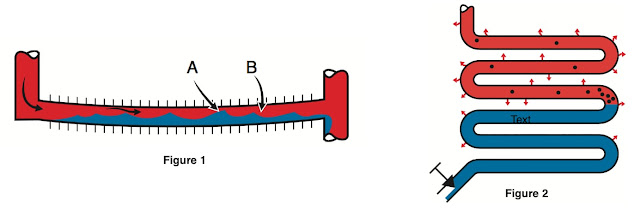
Condensate at the bottom of steam lines can cause one kind of water hammer. As it passes over this condensate at speeds of up to 100 miles per hour, steam creates "waves" (Fig. 1). If enough condensate forms, high-speed steam propels it forward, forming a dangerous slug that grows in size as it picks up liquid in front of it. Pipe fittings, regulating valves, tees, elbows, and blind flanges can all be destroyed as the slug changes direction. High-velocity water may erode fittings by chipping away at metal surfaces, in addition to causing damage from this "battering ram."

The necessity of draining the heat transfer unit. 

When steam comes into contact with condensate that has been cooled below the steam temperature, it can cause thermal shock, another type of water hammer. Steam has a much larger volume than condensate, and when it suddenly collapses, it can send shock waves throughout the system. Water hammer of this type can damage equipment and indicates that condensate is not being drained from the system. 

Need to drain and remove gas from steam system

Condensate in the heat transfer unit obviously takes up space, reducing the physical size and capacity of the equipment. Prompt condensate removal keeps the equipment full of steam (Fig. 2). As steam condenses, it leaves a water film on the inside of the heat exchanger. Non-condensable gases do not flow away due to gravity. Instead, they build up as a thin film on the heat exchanger's surface, along with dirt and scale. All of these are potential heat transfer barriers (Fig. 3).
Corrosion from gasses

The requirement to remove air and CO2. 

During equipment startup and boiler feedwater, the air is always present. Dissolved carbonates in feedwater may also emit carbon dioxide gas. The gases are pushed to the walls of the heat exchangers by the steam velocity, where they may obstruct heat transfer. These gases must be removed along with the condensate; otherwise, the condensate drainage problem is exacerbated.

For more information on any aspect of industrial and commercial steam or hot water systems in the Rocky Mountain Region, contact Energy West Controls. Call 801-262-4477 or visit Energy-West.com.